Joined as a Yard Planner as a Fresher?

Dear reader, if you have recently joined a container terminal as a fresher, you might feel abandoned and might not know where to begin. As a yard planner what are the tasks you have to do? Let’s break down this little question part by part into sub parts and analyze.
Before beginning to learn about yard planning, you will have to have a brief knowledge about the yard of your container terminal. You can search about the topics below in your yard.
- What is a Block?
- What is a Section?
- What is a Stack?
- What is a Heap?
- What is a Transfer Zone?
And if you can search about more,
- Which areas of the yard will be used for which types of containers?
- How high will the yard be stacked?
- What rules do we have to follow about placement of containers?
- How do you manage containers in the yard?
- What is important to the flow of containers through your terminal?
First of all,
What is yard planning?
Yard planning is the strategic process of assigning and managing container storage space within a container terminal’s yard. It is a critical function that ensures the smooth flow of containers in and out of the terminal while optimizing space, minimizing handling efforts, and reducing operational delays.
Good yard plans make terminal operations efficient. A ‘healthy’ yard is a yard where container movements are fluid. The yard is the heart of the terminal.
Take a look at your company’s yard, here is an example of the structure of a yard, and how it looks. Let’s name this yard “Marine Diaries Yard”.
Recognize the Blocks, Sections and Stacks of the yard
Marine Diaries Yard
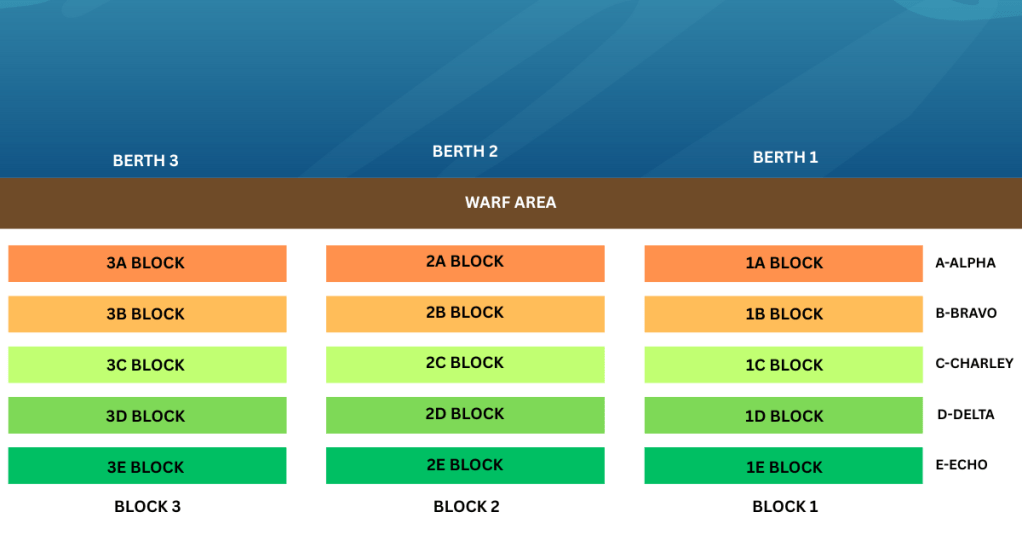
This yard has 3 separate yards/ main blocks call,
- Block 1
- Block 2
- Block 3
And also 5 different lanes call,
- Alpha (A)
- Bravo (B)
- Charley (C)
- Delta (D)
- Echo (E)
Under those main 3 yards and 5 different lanes, then create 15 different sub yards/ blocks,
Block 1,
- 1A Block (One Alpha Block)
- 1B Block (One Bravo Block)
- 1C Block (One Charley Block)
- 1D Block (One Delta Block)
- 1E Block (One Echo Block)
Block 2,
- 2A Block (Two Alpha Block)
- 2B Block (Two Bravo Block)
- 2C Block (Two Charley Block)
- 2D Block (Two Delta Block)
- 2E Block (Two Echo Block)
Block 3,
- 3A Block (Three Alpha Block)
- 3B Block (Three Bravo Block)
- 3C Block (Three Charley Block)
- 3D Block (Three Delta Block)
- 3E Block (Three Echo Block)
Parts of a Block
Let’s select one block from them and take a deeper look into that block.
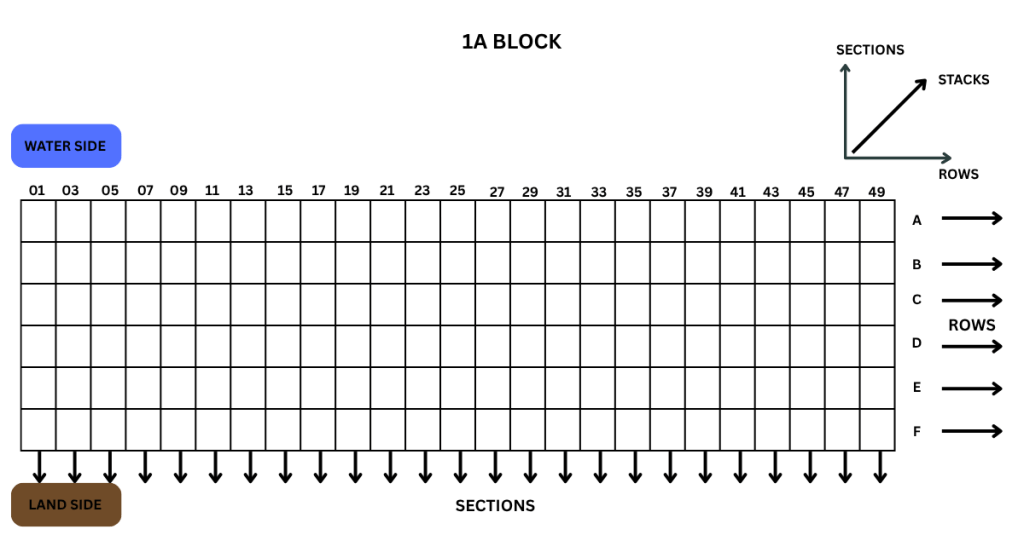
There are two sides for a block,
- Water side (Far Side)
- Land side (Near Side)
We call the vertical columns a section, and horizontal rows, “a row”. If you look closely, you can see all the sections have been renamed with odd numbers.
How to number a section?
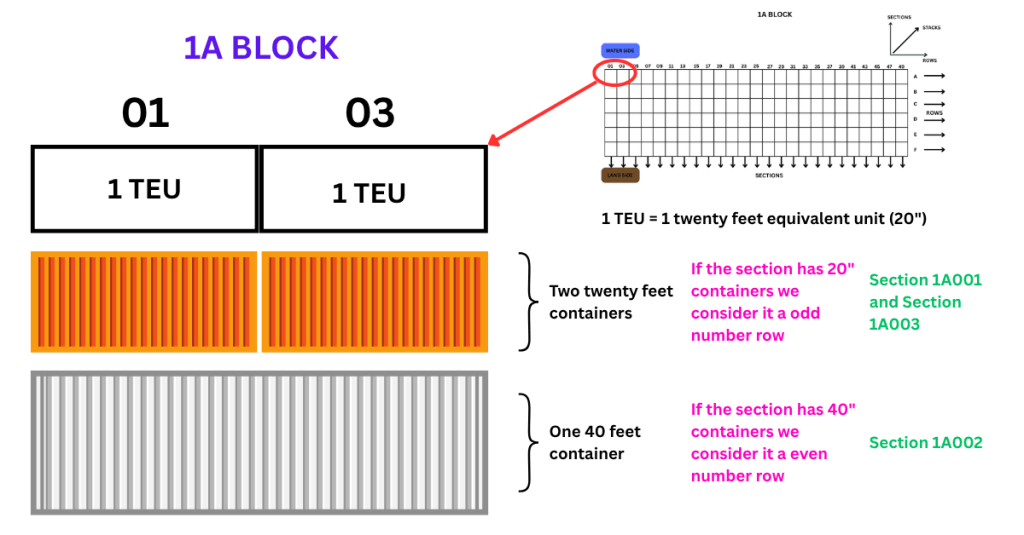
Each square in the yard represents 1 TEU and the meaning of it is “Twenty Feet Equivalent Unit”. Each 20 feet space represents with an “odd number”.Two twenty feet spaces create one 40 feet space. Those 40 feet space is represented with even numbers.
As you can see from the above image, if a section is dedicated to sack 20 feet containers, we call it as, 1A001 and 1A003 (with odd numbers). And if these two sections together create a 40 feet section, we call it as, 1A002 (with even number).
What is a Stack?
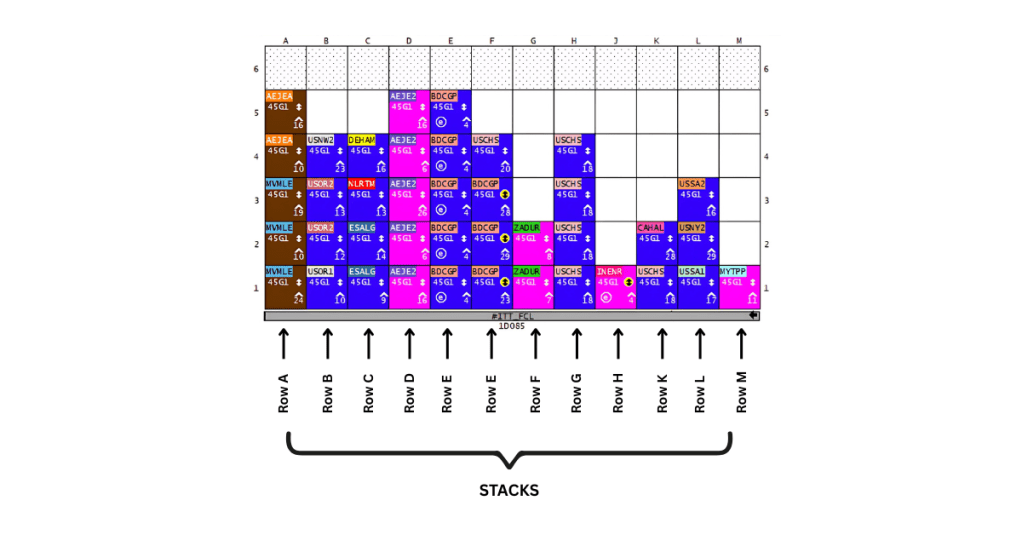
The above image represents a section and there are rows to this section. We call one tower of this section a stack in a container terminal. This section has 12 stacks and is renamed with 12 different row names.
Now we know how to name the areas of a yard of a container terminal.
Refresh your memory: Common container types
We have talked about common container types before, And again I will add a little note here about common container types. To dig more details about it you can click here.
- Dry (‘General Purpose’)
– 8’6” = standard height
– 9’6” = high-cube
- Flat Racks (ends that can be folded down to accommodate oversized loads)
- Open Side (aids loading/unloading certain cargo)
- Refrigerated (Temperature sensitive cargo)
- Insulated or Thermal (for long distance)
- Tanks (for liquids)
- Half-heights – half of a normal container in height
- Tunnels – doors on both ends
- Open Top (for oversized cargo)
Container ISO codes
ISO containers, also known as intermodal containers or shipping containers, are standardized cargo containers used for the efficient and secure transport of goods across different modes of transport—such as ships, trains, and trucks—without needing to unload and reload the cargo. These containers are governed by the International Organization for Standardization (ISO) under the standard ISO 668, which defines their dimensions, strength, and capacity requirements.
I am attaching the link to the full description of the container ISO codes article and you can read it all and know all the codes by clicking here.
Primary Objectives of Yard Planning
- Minimize container re-handles
- Reduce travel distance for container handling equipment (CHE)
- Avoid yard congestion
- Ensure timely availability of containers for vessel loading
- Improve space utilization and terminal productivity
What are Yard Planners trying to do?
The main task a yard planner does is feed containers to outbound carriers so there is never a holdup caused by getting a container out of the yard. Servicing a carrier on the berth is the highest priority.


Leave a Reply